The Question Behind the Question
People who ask me how to start rarely mean the practical steps. They mean something closer to: how do I know if I have the patience for this. That is a fair question, because patience is the actual job. The calligraphy, the restoration, the painting, all of it sits on top of a willingness to sit still and do the same motion a thousand times until it stops looking like effort.
So if someone came to me today, genuinely starting out, here is what I would say.
Learn to See Before You Learn to Write
Most people want to pick up the pen right away. I understand the pull. But the first year should be spent looking, not writing. Look at old letters until you can tell, without measuring, when a stroke is a hair too thick or a corner is a fraction off square. That eye takes longer to build than the hand does.
I spent years around people who had already trained that eye, before anyone let me touch parchment for real work. It felt slow at the time. It was not wasted time. Every restoration I do now depends on that early stretch of just watching.
Copy Before You Create
There is a temptation, especially if you also think of yourself as an artist, to want your own style right away. Resist that for a while. Copy the masters first. Copy them exactly, letter for letter, until your hand can produce the traditional forms without your mind fighting it. Style that shows up before the fundamentals are solid usually turns out to be a shortcut in disguise. Style that shows up after usually holds.
Expect the Boring Part to Be the Real Part
Nobody tells beginners that most of the work is preparation. Mixing ink correctly. Preparing the surface. Checking your tools before you start, not after something goes wrong. None of that is glamorous. All of it decides whether the finished piece lasts.
I would tell a beginner not to skip past the boring part looking for the satisfying part. The satisfying part is built out of the boring part done correctly, many times over.
Find Someone Who Will Correct You Out Loud
Self-teaching only goes so far here. You need someone willing to look at your work and tell you plainly what is wrong with it, not someone who softens everything to make you feel encouraged. I was fortunate to learn under people who corrected without hesitation. It stung sometimes. It also meant I was not carrying bad habits for years before anyone mentioned them.
If you are starting out, seek out that kind of honesty on purpose. Do not settle for praise. Ask for the correction.
Do Not Separate the Craft From the Reason for It
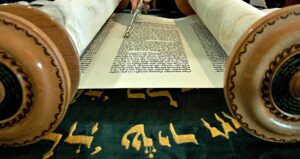
This is the part beginners underestimate most. The technical skill, on its own, produces competent work. What makes the work mean something is remembering, letter by letter, what it is for. A Torah scroll is not a canvas. A mezuzah is not decoration. When you hold that in mind while you work, the work changes, even if no one looking at the finished piece could tell you exactly how.
I would tell someone starting out to sit with that idea early, before the habits of the craft take over and the meaning becomes background noise. It is easier to build that awareness in from the start than to try to recover it later.
Travel If You Can, Early
Seeing how different communities hold the same tradition, and how scrolls and objects have aged in different places, teaches things a workshop cannot. It also teaches humility, because you see quickly how much has been done well by people before you, in conditions far harder than anything you will face.
The Honest Timeline
If someone wants a number, I will not pretend there is a shortcut version. Years, not months, before the fundamentals settle into the hand. More years before restoration work should be trusted to you. That is not meant to discourage anyone. It is meant to set the timeline honestly, so nobody quits at year two thinking they should already be finished learning.
Start slow, learn to see, find someone who will tell you the truth about your work, and keep the reason for the work in view the whole time. Everything else follows from that.